I have been seeing this advertisement, placed by Americans Against Food Taxes, every night on cable networks. It grated on my nerves the first time I saw it and I get more irritated with each subsequent viewing.
This fictional mother and her kids are shown driving through a neighborhood where families might be struggling to put food on the table, a foreclosed home, and then an "out of business" store front, finally arriving at her nice 2-story home in a well-to-do neighborhood, while driving a new car. I just don't buy the premise that she is indeed concerned that "those pennies add up."
I simply smell a Republican or a Libertarian who likes things just the way they are and has whatever selfish reasons for being opposed to a tax on sodas. If the average American soccer moms with the 2 1/2 children and the lovely homes on a bucolic suburban street are genuinely concerned about paying a soda tax, I'm quite sure they can find painless ways to offset the tax. How about adjusting the thermostat on the air conditioning one degree, or reducing the time the kids are slurping those sodas in front of the television by 30 minutes a day. Unplug a few gadgets in the house which you rarely use. Not only will you more than offset the soda tax, you'll be reducing your carbon footprint. Perhaps I'm asking too much.
The advertisement might have been more effective if the fictional family appeared to be living near the poverty level, driving a 15-year-old car, or taking the bus because they have no car.
On the other hand, perhaps it would be less effective because we don't really care much for seeing poverty in action. And some, including me, might wonder why a family barely squeaking by would be squandering money on sodas in the first place.
Another gripe I have is the way the soda tax proposals are being framed as a way to reduce obesity. Yes, it might work in a few instances, but that is clearly not the point, and it's a bad marketing move. It would make far more sense to frame it as a way to curtail tooth decay.
The fact that sugar-free sodas would be exempt also chaps my ass. The point of the tax is to raise billions of dollars in revenue from a non-essential product. If you are adamant against the tax, you can choose to opt out. And you know what? You'll be better off if you do! Sodas are not part of the food group pyramid and they have no positive health or nutritional benefits, even of they are sugar-free and caffeine-free. (At that level, I argue, what's the fucking point?! The only thing that isn't a big fat zero is the cost of it!)
Nevertheless, people with the financial means to buy sodas would continue to do so -- especially the addictive sodas with the caffeine -- and many people who are struggling financially would probably drop these unnecessary purchases. Many probably have already. And they will not suffer as a result, even if they cannot afford healthy, all-natural fruit juice. Why? Because there's absolutely nothing wrong with drinking water.
If we are serious about finding creative ways to pay for health care reform, or any of the dozens of other urgent needs in this country, we're going to have to buckle down and realize there is no free ride. We can do this in a variety of relatively painless ways, pennies here and pennies there, with all of us in this boat together, contributing in our own ways for a huge societal benefit, or we can fight and argue against any and every tax, regardless of how much or little it might affect us personally.
I am steadfastly against sales taxes on essential grocery items: dairy and soy products, grains, bread, beans, fruits and vegetables. However, we could makes huge strides in achieving and paying for universal health care by placing a small tax on non-essential items: processed foods, items packed with artificial flavors and colors, and candy! In doing so, we as a people would be promoting healthy responsible behavior while still allowing people the freedom to buy crap, if they can afford it. For those who can't afford it, they shouldn't be buying crap foods.
Whatever route we choose to go, you can bet your ass someone with a vested financial interest, particularly at the corporate level, isn't going to like it, and they will fight it. We must resist those fights.
Progress doesn't just happen; it requires an investment. It isn't free, nor is it cheap. But it is essential if we are to survive and prosper in the long run.

Showing posts with label Future. Show all posts
Showing posts with label Future. Show all posts
Saturday, September 26, 2009

Monday, August 24, 2009
Trains, Planes and Automobiles
Robert J. Samuelson, in an op-ed piece for the Washington Post, issues a rather blistering critique of President Obama's vision for a high-speed rail network in the United States.
Given the billions being tossed around lately, from Iraq to Afghanistan, from the US bank bailouts to the General Motors rescue, not to mention another $3+ billion in the Cash for Clunkers program, $125 billion for TEN 250-mile rail systems seems like quite a deal, and represents a fraction of the economic stimulus package which has yet to make an impact on most Americans, particularly those unemployed.
I'm certainly willing to concede that, as Mr. Samuelson asserts, we have lack-of-density issues in this country which work against the notion of a successful rail network.
True, but Obama isn't proposing a vast rail network along the lines of our interstate highway system. No one is talking about high-speed rail between Amarillo and Albuquerque (yet). The focus is in areas where there already is significant population density and frequent airline service between metropolitan areas -- often hourly air service! I can't imagine a scenario more worthy of frequent high-speed rail service to help ease congestion in the air and to provide quick alternatives for airline travel.
Moreover, as the population continues to climb in the US, with more people clustering in urban areas, trains are only going to make more sense as time drags on, not less. But I'll confess it does seem to be very American to wait until a need is overdue -- and even more costly years down the road -- than prepare now for what is going to be an inevitable necessity. And let us not forget the uncertainty of fuel prices which, at some point in the future, are going to start rising again.
Here is a map illustrating some of the proposed high-speed rail corridors.
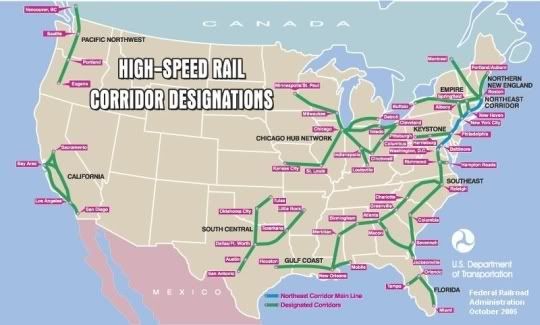
This makes perfect sense to me as a starting point. Regional rail networks would definitely help to alleviate air travel congestion where they can actually compete with airlines in total travel time. An Austin to Dallas route for example, at around 200 miles should easily be managed in less than 2 hours by high-speed rail, and be significantly more pleasurable that sitting around for 45 minutes in the airport prior to departure, and after having endured the unpleasant security aspects, had your nail clippers and large shampoo bottle confiscated, etc.
Excessive security is precisely the reason I choose not to fly except when absolutely necessary, and I haven't flown anywhere in a number of years. However, I do drive between Austin and Little Rock at least once a year, and that trip takes close to 8 hours if I hustle and keep my rest stops to a minimum. If I had the opportunity to board a high-speed train here in Austin and arrive in Little Rock in roughly five hours, I seriously doubt I'd ever make the grueling drive again.
And because that travel time is about the same as air travel when you factor in the waiting time and layover in Dallas, it would compete quite nicely.
While Texas and Florida certainly have some population density issues which beg for development of high-speed rail options, California certainly is viable.
The California High-Speed Rail Authority has a beautiful and exciting web site illustrating the vision of high-speed rail and even includes some simulated videos which are thrilling to watch. Check out a few of the "Trip Visualizations."
The time to move forward on this is now, not 30 years down the road.
The White House promises fabulous benefits. High-speed rail "will loosen the congestion suffocating our highways and skyways," says Vice President Biden. A high-speed rail system would eliminate carbon dioxide emissions "equal to removing 1 million cars from our roads," adds the president. Relieve congestion. Fight global warming. Reduce oil imports. The vision is seductive. The audience is willing. Many Americans love trains and regard other countries' systems (say, Spain's rapid trains between Madrid and Barcelona, running at about 150 mph) as evidence of U.S. technological inferiority.
There's only one catch: The vision is a mirage. The costs of high-speed rail would be huge, and the public benefits meager.
[...]
In a recent report, the Government Accountability Office cited a range of construction costs, from $22 million a mile to $132 million a mile. Harvard economist Edward Glaeser figures $50 million a mile might be a plausible average. A 250-mile system would cost $12.5 billion and 10 systems, $125 billion.
Given the billions being tossed around lately, from Iraq to Afghanistan, from the US bank bailouts to the General Motors rescue, not to mention another $3+ billion in the Cash for Clunkers program, $125 billion for TEN 250-mile rail systems seems like quite a deal, and represents a fraction of the economic stimulus package which has yet to make an impact on most Americans, particularly those unemployed.
I'm certainly willing to concede that, as Mr. Samuelson asserts, we have lack-of-density issues in this country which work against the notion of a successful rail network.
What works in Europe and Asia won't in the United States. Even abroad, passenger trains are subsidized. But the subsidies are more justifiable because geography and energy policies differ.
Densities are much higher, and high densities favor rail with direct connections between heavily populated city centers and business districts.
True, but Obama isn't proposing a vast rail network along the lines of our interstate highway system. No one is talking about high-speed rail between Amarillo and Albuquerque (yet). The focus is in areas where there already is significant population density and frequent airline service between metropolitan areas -- often hourly air service! I can't imagine a scenario more worthy of frequent high-speed rail service to help ease congestion in the air and to provide quick alternatives for airline travel.
Moreover, as the population continues to climb in the US, with more people clustering in urban areas, trains are only going to make more sense as time drags on, not less. But I'll confess it does seem to be very American to wait until a need is overdue -- and even more costly years down the road -- than prepare now for what is going to be an inevitable necessity. And let us not forget the uncertainty of fuel prices which, at some point in the future, are going to start rising again.
Here is a map illustrating some of the proposed high-speed rail corridors.
This makes perfect sense to me as a starting point. Regional rail networks would definitely help to alleviate air travel congestion where they can actually compete with airlines in total travel time. An Austin to Dallas route for example, at around 200 miles should easily be managed in less than 2 hours by high-speed rail, and be significantly more pleasurable that sitting around for 45 minutes in the airport prior to departure, and after having endured the unpleasant security aspects, had your nail clippers and large shampoo bottle confiscated, etc.
Excessive security is precisely the reason I choose not to fly except when absolutely necessary, and I haven't flown anywhere in a number of years. However, I do drive between Austin and Little Rock at least once a year, and that trip takes close to 8 hours if I hustle and keep my rest stops to a minimum. If I had the opportunity to board a high-speed train here in Austin and arrive in Little Rock in roughly five hours, I seriously doubt I'd ever make the grueling drive again.
And because that travel time is about the same as air travel when you factor in the waiting time and layover in Dallas, it would compete quite nicely.
While Texas and Florida certainly have some population density issues which beg for development of high-speed rail options, California certainly is viable.
The California High-Speed Rail Authority has a beautiful and exciting web site illustrating the vision of high-speed rail and even includes some simulated videos which are thrilling to watch. Check out a few of the "Trip Visualizations."
The time to move forward on this is now, not 30 years down the road.
Saturday, October 04, 2008
The Cuban Proclamation
When Cuba gets liberated, that country will be the center of our musical universe.
Subscribe to:
Posts (Atom)