Showing posts with label Transportation. Show all posts

Monday, August 24, 2009

Trains, Planes and Automobiles

Robert J. Samuelson, in an op-ed piece for the Washington Post, issues a rather blistering critique of President Obama's vision for a high-speed rail network in the United States.
The White House promises fabulous benefits. High-speed rail "will loosen the congestion suffocating our highways and skyways," says Vice President Biden. A high-speed rail system would eliminate carbon dioxide emissions "equal to removing 1 million cars from our roads," adds the president. Relieve congestion. Fight global warming. Reduce oil imports. The vision is seductive. The audience is willing. Many Americans love trains and regard other countries' systems (say, Spain's rapid trains between Madrid and Barcelona, running at about 150 mph) as evidence of U.S. technological inferiority.

There's only one catch: The vision is a mirage. The costs of high-speed rail would be huge, and the public benefits meager.

[...]

In a recent report, the Government Accountability Office cited a range of construction costs, from $22 million a mile to $132 million a mile. Harvard economist Edward Glaeser figures $50 million a mile might be a plausible average. A 250-mile system would cost $12.5 billion and 10 systems, $125 billion.

Given the billions being tossed around lately, from Iraq to Afghanistan, from the US bank bailouts to the General Motors rescue, not to mention another $3+ billion in the Cash for Clunkers program, $125 billion for TEN 250-mile rail systems seems like quite a deal, and represents a fraction of the economic stimulus package which has yet to make an impact on most Americans, particularly those unemployed.

I'm certainly willing to concede that, as Mr. Samuelson asserts, we have lack-of-density issues in this country which work against the notion of a successful rail network.
What works in Europe and Asia won't in the United States. Even abroad, passenger trains are subsidized. But the subsidies are more justifiable because geography and energy policies differ.

Densities are much higher, and high densities favor rail with direct connections between heavily populated city centers and business districts.

True, but Obama isn't proposing a vast rail network along the lines of our interstate highway system. No one is talking about high-speed rail between Amarillo and Albuquerque (yet). The focus is in areas where there already is significant population density and frequent airline service between metropolitan areas -- often hourly air service! I can't imagine a scenario more worthy of frequent high-speed rail service to help ease congestion in the air and to provide quick alternatives for airline travel.

Moreover, as the population continues to climb in the US, with more people clustering in urban areas, trains are only going to make more sense as time drags on, not less. But I'll confess it does seem to be very American to wait until a need is overdue -- and even more costly years down the road -- than prepare now for what is going to be an inevitable necessity. And let us not forget the uncertainty of fuel prices which, at some point in the future, are going to start rising again.

Here is a map illustrating some of the proposed high-speed rail corridors.


This makes perfect sense to me as a starting point. Regional rail networks would definitely help to alleviate air travel congestion where they can actually compete with airlines in total travel time. An Austin to Dallas route for example, at around 200 miles should easily be managed in less than 2 hours by high-speed rail, and be significantly more pleasurable that sitting around for 45 minutes in the airport prior to departure, and after having endured the unpleasant security aspects, had your nail clippers and large shampoo bottle confiscated, etc.

Excessive security is precisely the reason I choose not to fly except when absolutely necessary, and I haven't flown anywhere in a number of years. However, I do drive between Austin and Little Rock at least once a year, and that trip takes close to 8 hours if I hustle and keep my rest stops to a minimum. If I had the opportunity to board a high-speed train here in Austin and arrive in Little Rock in roughly five hours, I seriously doubt I'd ever make the grueling drive again.

And because that travel time is about the same as air travel when you factor in the waiting time and layover in Dallas, it would compete quite nicely.

While Texas and Florida certainly have some population density issues which beg for development of high-speed rail options, California certainly is viable.

The California High-Speed Rail Authority has a beautiful and exciting web site illustrating the vision of high-speed rail and even includes some simulated videos which are thrilling to watch. Check out a few of the "Trip Visualizations."

The time to move forward on this is now, not 30 years down the road.

Monday, May 12, 2008

First Day On The Job

I hopped on the Oak Hill Flyer #171 at 7:40 this morning for the ride downtown to start my new job at the place where I was laid off in December. I got a picture after I boarded the bus but apparently it was a bumpy ride.


I was at my office by 8:20 which isn't bad considering the place where I exit the bus is still half a mile from my office. And $1.00 roundtrip -- about 19 miles total. I was pretty thankful for that when I noticed that gas is above $3.90 for premium.

Nothing too eventful today at work. The entire day was spent in orientation which was a breeze considering I had almost a year head-start on the other two newly hired individuals.

My desk is just a couple of cubes away from my old one.

I'm not sure how long before I can get settled back into a normal routine and start posting again. Don't abandon me yet!

Saturday, May 10, 2008

Mass Transit Use On The Rise

Last spring when I was taking the commuter bus into downtown Austin to work I would notice a spike in ridership whenever fuel prices were on the rise. As I'm starting back to work on Monday, I am looking forward to seeing the numbers now almost a year since I last rode the bus.

It's nice to see more people using mass transit.
Mass transit systems around the country are seeing standing-room-only crowds on bus lines where seats were once easy to come by. Parking lots at many bus and light rail stations are suddenly overflowing, with commuters in some towns risking a ticket or tow by parking on nearby grassy areas and in vacant lots.

Unfortunately I have a new fear. I hope the cities are able to keep up with the demand by increasing service.
But meeting the greater demand for mass transit is proving difficult. The cost of fuel and power for public transportation is about three times that of four years ago, and the slowing economy means local sales tax receipts are down, so there is less money available for transit services. Higher steel prices are making planned expansions more expensive. Denver is already having issues.

And of course, my other concern is if my bus is standing-room-only, I'm going to have a difficult time dealing with that.

Tuesday, April 15, 2008

When Airlines Copulate

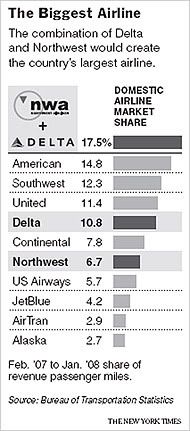
Mr. Pessimism here again to express a few words about the merger of Northwest and Delta. I'll be watching the news of this one with a very close eye -- wondering when the announcement of layoffs and closing of hubs will come.

As if this isn't enough, expect United and Continental to start engaging in foreplay in anticipation of consummating their marriage while the merger pimp-in-chief is still around to bestow his blessing.
Other airlines may rush to merge. One reason for the urgency is that airlines want to get their deals approved by the Justice Department under the Bush administration, rather than risk seeing them stall until a new president takes office.

As for expected job losses, do the math:
At the end of 2007, Delta and Northwest employed a combined 89,000 workers. American Airlines, currently the largest carrier, had 85,500. Delta said the combined airline would employ 75,000 people. That number excludes 6,000 people who work at Delta’s regional airline and Delta said earlier that it would reduce employment by 2,000.

Although Delta said no hubs would be closed, that is by no means a statement that there will not be reductions, or eventual closing of hubs. They are going to do what it takes to streamline. The end result might not be very favorable to travelers or employees in the potentially redundant hubs.
Pardus Capital Management, an investment firm, estimated in November that a combination of Delta and Northwest could reduce costs by about $1.5 billion a year, in large part by combining hubs. Delta’s hub in Cincinnati is close to Northwest’s in Detroit. And Northwest’s hub in Memphis is close to Delta’s in Atlanta.

In other words, if I were en employee in Detroit or Memphis, I'd start having trouble sleeping right about now.

Sunday, February 10, 2008

Playing Around With $152 Billion, And Then Some

As President Bush prepares to sign the $152 billion stimulus package bill on Wednesday, I keep wondering how much this is really going to help the economy or whether it will represent a one-time blip for a number of retailers.

I also keep thinking about what else could be done with $152 billion which might have a more lasting impact. Forget starting another war; $152 billion doesn't seem to go very far when the Pentagon is handling things. We're already up to about $200 billion for 2007-2008 and if we don't pull the plug on it soon, we're talking numbers in the trillions. A trillion is a thousand billion if I recall.

What $152 billion would do is pay for at least 75% of the Trans-Texas Corridor. Unfortunately the cost of nearly $200 billion is being put up by private investors and the bulk of it will be toll-roads.

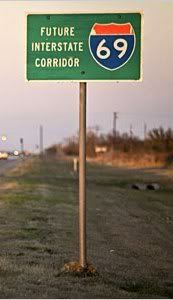
There's also the controversial Interstate 69, or "NAFTA highway" as some call it, stretching from Mexico to Canada, and passing the northern edge of my hometown coincidentally -- an area not exactly blessed with easy freeway access.

For all the potential drawbacks, I'm quite certain a freeway in that area would be beneficial for bringing new jobs which are sorely needed. Where there's an exit, there are gas stations, restaurants, and maybe a motel or two. And such an important freeway could potentially attract industry along the route.

In an article from 2006, the cost for the 185-mile Arkansas portion was reported to be $1.7 billion with the cost for the entire corridor estimated at $17 billion.

Even throwing in a few extra billion for inflation or cost overruns, it seems to me that the $153 billion stimulus package could do a lot of good for our nation, just using new highways as an example.

Prefer public transit? Since 1971, Amtrak has received over $40 billion.

Here in Austin, Capital Metro has projected a cost of $1.9 billion for a 52 mile light-rail system. Granted, there are many who feel that number is unrealistic. Even if it ended up cost $3 billion, that's less than 2% of the cost of the economic stimulus package. And for those of you who are familiar with Austin traffic, such a rail system could be a great benefit to our city.

In Dallas, they are building a 21-mile project in addition to existing rail options, with a $700 million grant from the Federal Transit Administration. Gee, that's less than ONE billion dollars.
Earlier, a study released in May 2007 by the University of North Texas Center for Economic Development and Research projected that DART’s existing and soon-to-be-expanded LRT system will stimulate more than $8 billion in economic activity.


I could keep going with this but I think you get the idea. It's fun to see what we could do with $152 billion. Now imagine if we had all that money back from Iraq.